
In an increasingly demanding industrial environment, standard solutions are no longer enough. Companies now seek customized technical responses, more efficient processes, and closer collaboration with their suppliers. In this context, our Applications Department has become a key element in transforming complex needs into tangible solutions.
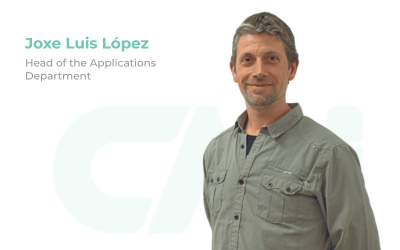
We spoke with Joxe Luis López Ardura, head of the department, to share how we develop customized technical proposals, the challenges we face every day, and how we prepare to stay ahead in a constantly evolving market.

From Need to Solution: How We Work in Applications
1. How would you define the role of the Applications Department within CMI Durango?
We act as the technical and economic bridge between the customer’s needs and the proposal we develop to address them. We interpret, analyze, and shape each request until it becomes a viable solution.
2. What do we contribute to the commercial process and the technical development of each project?
Knowledge and precision. Our work allows us to offer the customer exactly what they need, at the most competitive cost. Moreover, when a project becomes an order, it starts from a well-defined basis, which streamlines all subsequent phases—design, procurement, assembly, and commissioning. It also helps us clearly establish time and cost targets for each workgroup or production stage.

3. What kind of inquiries do we receive through the sales team?
They vary widely. Sometimes we receive a request for a part with very specific requirements (dimensions, cycle times, accuracy), and other times the challenge involves integrating multiple operations into a single machine. We also handle retrofitting projects, ranging from extending the service life of equipment to upgrading it with new functionalities. Whenever a customer explains what they aim to achieve, we can identify opportunities for improvement—thanks to the constant evolution of the sector.
4. How do we turn those needs into realistic and forward-looking proposals?
We have a team with extensive experience in technical design and conception work, capable of adapting each request to our existing know-how or developing new calculations to validate its feasibility. We analyze each case, define the optimal solution, and develop the proposal considering all phases of the project.

Designing What Doesn’t Yet Exist: Technical Challenges and Our Way of Working
5. Designing tailor-made solutions isn’t easy. What are the main challenges we face?
The greatest challenge arises when we must step outside standard designs or when a retrofitting project requires integrating new functionalities into an existing structure.
6. How do we approach the technical analysis of a new application?
We first define the required machine model and the dimensions it must handle. Then we analyze the technical requirements (power, RPM, feed rates, etc.), followed by the auxiliary components—heads, changers, pallet systems, and so on. This process allows us to classify each project as standard, special, or highly special.
7. What criteria do we follow to assess the technical feasibility of a project?
For new projects, we focus on part dimensions and functional requirements. For retrofitting, we analyze whether the existing structure can support the new specifications or if structural modifications are needed.

8. How do we collaborate with the engineering and production teams?
We can work autonomously, but when complexity demands it, we collaborate closely with both areas. The technical office supports us with calculations, preliminary studies, and validations, while production helps define timing, assembly stages, and work guidelines. This coordination is key to ensuring all departments are aligned from the very beginning.
Each Project: A Story of Engineering and Collaboration
9. Which project stands out in particular?
Recently, we worked on the refurbishment of a machine. To validate its feasibility, we conducted simulations at the customer’s site using a similar machine. This action built trust and facilitated decision-making—an excellent example of the commitment we bring to every project.

10. What do we aim to contribute beyond technical analysis?
We aim to engage with the customer and collaborate to deliver a personalized, reliable, and long-lasting solution, always with a long-term perspective and at the best possible cost.
11. What sets us apart as designers of industrial process solutions?
Our ability to adapt and design customized machines, combined with the robustness and durability of our products. This combination enables us to provide genuine, sustainable value.

Motivation, Experience, and the Future of the Applications Department
12. What motivates you most about your work?
Knowing that we can deliver real solutions where others can’t. That ability to adapt and provide specific answers to each customer’s challenges truly defines who we are.
13. How do you envision the department’s evolution in the coming years?s?
With more tools, more structured knowledge, and a solid database, our work will become increasingly agile. This will allow us to dedicate more time to special cases and to the integration of new technologies.
Innovation Through Listening
Our Applications Department represents a clear commitment to applied engineering with strategic vision. Solid, tailor-made proposals that are born from active listening and built on shared technical expertise.
Because delivering custom solutions means understanding each process, anticipating what’s next, and providing answers that generate real impact.